What Happens When You Quit Sugar for 7 Days: A Day-by-Day Timeline
Discover what happens when you quit sugar for 7 days. Learn how a one-week detox alters your brain chemistry, stabilizes energy, stops bloating, and clears skin.
Sugar is no longer just an occasional treat reserved for birthdays and celebrations. Today, it has become a daily habit woven into almost every modern diet. It hides silently in our breakfast cereals, flavored yogurts, sports drinks, salad dressings, pasta sauces, and even foods marketed as “healthy” organic options.
Because of this hidden infiltration, most people consume massive amounts of added sweetening agents without even realizing it.
The numbers are staggering. The average person now eats roughly 17 teaspoons of added sugar every single day—which is nearly three times more than what leading health experts recommend. This constant overconsumption keeps our bodies trapped in a continuous cycle of inflammation, weight gain, and energy crashes.
So what would happen if you suddenly stopped consuming it? Not forever. Not for an entire month. Just for seven days.
The concept of a short-term detox might sound simple, but what happens when you quit sugar for 7 days is far more dramatic than most people expect. Within the first 24 hours, your brain chemistry begins to shift. By Day 2, withdrawal symptoms can hit hard. By Day 4, your internal energy systems start rebuilding themselves. And by Day 7, some people barely recognize the refreshed person staring back at them in the mirror.
Let’s break down the exact hour-by-hour and day-by-day transformation your body experiences during a short-term sugar detox.
Day 1 to Day 2: The Crash & The Withdrawal
Day 1 usually feels completely manageable. Your motivation is at an all-time high, your discipline is strong, and you feel entirely focused and determined. You confidently skip the morning sugary coffee drink, walk right past the candy aisle, and proudly say no to dessert after dinner. At first, your body barely reacts to the change.
However, beneath the surface, an important biological shift is already taking place. Your brain runs heavily on glucose—a simple form of sugar used as a rapid, preferred fuel source. When that constant, predictable stream suddenly disappears, your central nervous system notices immediately. Your blood sugar levels begin to drop, and your brain starts asking where its quick energy went.
By Day 2, reality sets in. This is the exact moment when many people experience what experts call a “sugar crash” or a “sugar hangover.” Understanding what happens when you quit sugar for 7 days means preparing for these common physical and emotional symptoms:
Throbbing Headaches: Caused by changes in brain blood flow as glucose levels drop.
Rapid Mood Swings & Irritability: Your patience wears thin as your body lacks its usual chemical comfort.
Physical Fatigue: A temporary slump as your body struggles to find an alternative fuel source.
Severe Brain Fog: Difficulty concentrating or remembering simple tasks.
Intense, Uncontrollable Cravings: A desperate internal urge to consume anything sweet.
This occurs because sugar stimulates dopamine—the exact brain chemical connected to pleasure, reward, and motivation. Every soda, cookie, and sweet snack creates tiny reward spikes inside your nervous system. Over time, your brain becomes heavily dependent on those artificial spikes. When they vanish, dopamine activity drops sharply, triggering withdrawal.
Cravings during this initial phase can feel surprisingly emotional. You may find yourself suddenly obsessing over chocolate, pastries, soda, or even white bread. This happens not because you are weak-willed, but because your body is temporarily fighting a biochemical battle to restore a familiar chemical pattern. This is universally recognized as the hardest stage of the entire detox. Most people quit right here, but if you can survive the first 48 hours, your body begins preparing for a powerful metabolic reset.
Day 3: The Metabolic Pivot
Day 3 is where the deep, internal transformation truly begins. By this point, your body has completely burned through much of its stored glycogen—the backup sugar reserve kept inside your liver and your muscles. Normally, your body prefers utilizing quick sugar because it requires very little effort to convert into energy. But on Day 3, that easy fuel tank is running on empty, forcing your metabolism to adapt or starve.
With less glucose entering your bloodstream, your pancreas stops pumping out high amounts of insulin. Insulin is the hormone primarily responsible for clearing sugar from the blood and helping store any excess as body fat. When insulin levels drop, your cells finally receive biological permission to access stored fat for energy.
The Science of Fat Burning: This metabolic shift is known as lipolysis—the chemical breakdown of stored fat cells into usable, burning fuel. For many individuals, this detox is the first time in years that their body has seriously relied on fat stores instead of constant carbohydrate intake.
While lipolysis is fantastic news for your health goals, Day 3 can feel strange physically. Your digestive system and your gut bacteria are undergoing a massive adjustment period. Certain harmful bacteria and strains of yeast inside your microbiome thrive exclusively on simple sugars. When it disappears from your meals, those microbes begin to starve.
Ironically, as these bad microbes die off, they increase your cravings even more. Current scientific research suggests that gut microbes can influence appetite signals sent directly to the brain through the gut-brain axis. That is why cravings on Day 3 feel incredibly specific.
You don’t just want food; you want highly processed foods like pizza, ice cream, cookies, or soda. This is your body actively fighting its old lifestyle habits.
The best way to win this specific stage is to flood your body with hydration, essential electrolytes, healthy fats (like avocados and nuts), clean protein, and extra sleep.
Day 4 to Day 5: The Dopamine Shift & Energy Surge
Then suddenly, around Day 4 and Day 5, everything changes. The lingering mental fog begins to lift. You wake up in the morning feeling genuinely clearer, lighter, and more naturally alert. For the first time since starting the challenge, those nagging cravings begin to lose their iron grip on your mind.
Why does this sudden relief happen? It occurs because your blood sugar has finally stabilized. When evaluating what happens when you quit sugar for 7 days, this phase marks the end of the energy roller coaster.
When you regularly consume processed foods, your daily energy behaves like a chaotic amusement park ride. You experience a sharp spike, a brutal crash, another spike, and another crash. Without added sweetening agents, your energy levels flatten out into a highly consistent stream.
Instead of short bursts followed by extreme fatigue, your body produces clean, sustainable vitality. Many people notice a surprising side effect here: they no longer feel the need for multiple cups of coffee or energy drinks just to survive the afternoon.
Simultaneously, your taste buds begin a profound resetting process. Processed sugar is formulated to be so intensely sweet that it completely dulls your sensory sensitivity to natural flavors. After several days of abstinence, natural whole foods suddenly taste incredible.
An ordinary apple tastes intensely sweet, fresh blueberries taste remarkably rich, and even raw carrots reveal a surprisingly flavorful profile. Your brain’s reward system is successfully recalibrating itself, helping you realize you weren’t actually hungry for sugar—you were merely dependent on the cycle.
Day 6 to Day 7: The Mirror Results
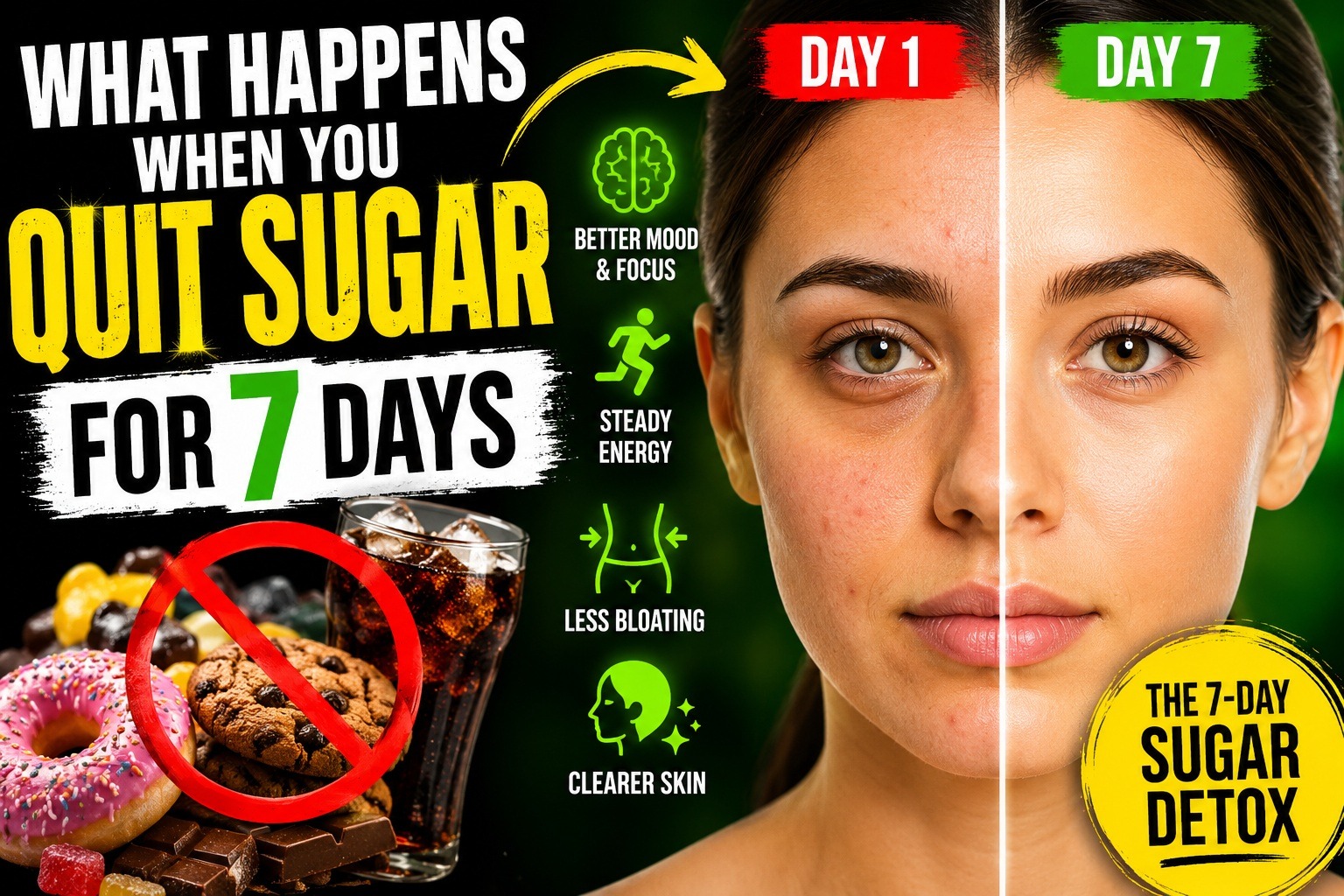
By Day 6 and Day 7, the internal changes finally manifest visibly. This is the rewarding milestone where people look in the bathroom mirror and notice a genuine physical difference.
3 to 5 lbs dropped (mostly water weight); flatter stomach.
Facial Structure
Systemic inflammation creates facial puffiness.
Reduced puffiness; sharper jawline and facial definition.
Skin Tone & Texture
Glycation damages collagen; spikes acne and oil.
Clearer, brighter, less oily, and deeply hydrated skin.
Mental Performance
Brain is trapped in constant highs and crashes.
Enhanced mental clarity, sharper focus, and stable moods.
Let’s look closer at the bloating and weight loss. It is incredibly common for individuals to lose between 3 to 5 pounds during their first week. To be completely transparent, the vast majority of this rapid loss is not pure body fat; it is water weight.
Your body stores carbohydrates in the form of glycogen, and every single gram of glycogen holds onto roughly three to four grams of water. As your glycogen levels drop during the detox, your body flushes out that excess retained water.
The visual result is less systemic puffiness, a noticeably flatter stomach, sharper facial definition, and clothes that suddenly feel loose.
Furthermore, your skin quality improves dramatically due to reduced inflammation and the cessation of a process known as glycation. Glycation occurs when excess sugar molecules bind to collagen and elastin—the vital proteins responsible for keeping your skin firm, bouncy, and youthful.
When these proteins are damaged by sugar, it accelerates aging, deepens wrinkles, and worsens conditions like acne or facial redness. By Day 7, your body-wide inflammation decreases noticeably, leaving your skin looking clearer, brighter, and naturally glowing.
Beyond the physical appearance, the most valuable change is mental clarity. With your brain no longer trapped inside a toxic cycle of highs and crashes, you gain sharper focus, better mood stability, and enhanced emotional control.
Conclusion: what happens when you quit sugar for 7 days
The Long-Term Verdict
Reviewing the comprehensive timeline of what happens when you quit sugar for 7 days reveals an impressive list of biological victories:
Your insulin levels stabilize, opening the doors to efficient fat burning.
Your gut microbiome shifts away from harmful, sugar-loving yeast toward a healthier microbial balance.
Your intense psychological cravings weaken substantially.
Your daily energy levels become smooth and dependable.
Your skin clears up, and abdominal bloating decreases.
Your mind feels sharper, calmer, and entirely re-energized.
Does this mean sugar is inherently evil and you can never enjoy a slice of birthday cake or a holiday dessert ever again? Absolutely not. Life is meant to be lived and enjoyed to the fullest.
However, a temporary 7-day reset teaches your mind a deeply powerful lesson: your body does not genuinely need processed sugar to function at its absolute best. You can feel highly energized, deeply focused, entirely satisfied, and mentally sharp without constantly feeding an artificial cycle.
Once you experience that true metabolic freedom, you will permanently look at food differently—no longer as emotional entertainment, but as premium fuel for your life.
Disclaimer: This article is for educational and informational purposes only and is not intended to replace professional medical advice, diagnosis, or treatment. Always consult with a qualified healthcare provider before making significant dietary or lifestyle changes, especially if you live with diabetes, hypoglycemia, or any underlying medical condition.
A graduate of Computer Science and Information Management Technology. Diploma – Caregiving, Certificates – Dementia and Diabetes Awareness and Management. A researcher, blogger, songwriter, singer and acoustic guitarist. Born in an environment where natural talents such as healing are imparted at our natural birth. This natural talents of healing is the result of our genetic inheritance and the training from family environment.
Related Posts:
Sugar Cane Benefits Sugar Cane Benefits on Health Sugar cane benefits are very…
We use cookies on our website to give you the most relevant experience by remembering your preferences and repeat visits. By clicking “Accept All”, you consent to the use of ALL the cookies. However, you may visit "Cookie Settings" to provide a controlled consent.
This website uses cookies to improve your experience while you navigate through the website. Out of these, the cookies that are categorized as necessary are stored on your browser as they are essential for the working of basic functionalities of the website. We also use third-party cookies that help us analyze and understand how you use this website. These cookies will be stored in your browser only with your consent. You also have the option to opt-out of these cookies. But opting out of some of these cookies may affect your browsing experience.
Necessary cookies are absolutely essential for the website to function properly. These cookies ensure basic functionalities and security features of the website, anonymously.
Cookie
Duration
Description
cookielawinfo-checkbox-analytics
11 months
This cookie is set by GDPR Cookie Consent plugin. The cookie is used to store the user consent for the cookies in the category "Analytics".
cookielawinfo-checkbox-functional
11 months
The cookie is set by GDPR cookie consent to record the user consent for the cookies in the category "Functional".
cookielawinfo-checkbox-necessary
11 months
This cookie is set by GDPR Cookie Consent plugin. The cookies is used to store the user consent for the cookies in the category "Necessary".
cookielawinfo-checkbox-others
11 months
This cookie is set by GDPR Cookie Consent plugin. The cookie is used to store the user consent for the cookies in the category "Other.
cookielawinfo-checkbox-performance
11 months
This cookie is set by GDPR Cookie Consent plugin. The cookie is used to store the user consent for the cookies in the category "Performance".
viewed_cookie_policy
11 months
The cookie is set by the GDPR Cookie Consent plugin and is used to store whether or not user has consented to the use of cookies. It does not store any personal data.
Functional cookies help to perform certain functionalities like sharing the content of the website on social media platforms, collect feedbacks, and other third-party features.
Performance cookies are used to understand and analyze the key performance indexes of the website which helps in delivering a better user experience for the visitors.
Analytical cookies are used to understand how visitors interact with the website. These cookies help provide information on metrics the number of visitors, bounce rate, traffic source, etc.
Advertisement cookies are used to provide visitors with relevant ads and marketing campaigns. These cookies track visitors across websites and collect information to provide customized ads.