15 Things You Can Mix With Castor Oil for Hair & Skin
15 Things You Can Mix With Castor Oil for Hair & Skin
Discover 15 things you can mix with castor oil for hair and skin, including ginger, rosemary, coconut oil, aloe vera, turmeric, and more.
Have you ever wondered why castor oil has remained a popular natural wellness ingredient for generations?
If you’ve ever handled pure castor oil, you already know that it is uniquely thick, sticky, and not exactly the most exciting-looking product in your bathroom cabinet. Yet despite its unusual texture, castor oil has been used in traditional beauty and wellness practices for a very long time.
People have used it for hair care, skin conditioning, massage, and various traditional remedies. But castor oil doesn’t always have to be used by itself.
In fact, there are many natural ingredients that people combine with castor oil to create homemade hair and skin treatments. Some of these combinations are familiar, while others are surprisingly unusual.
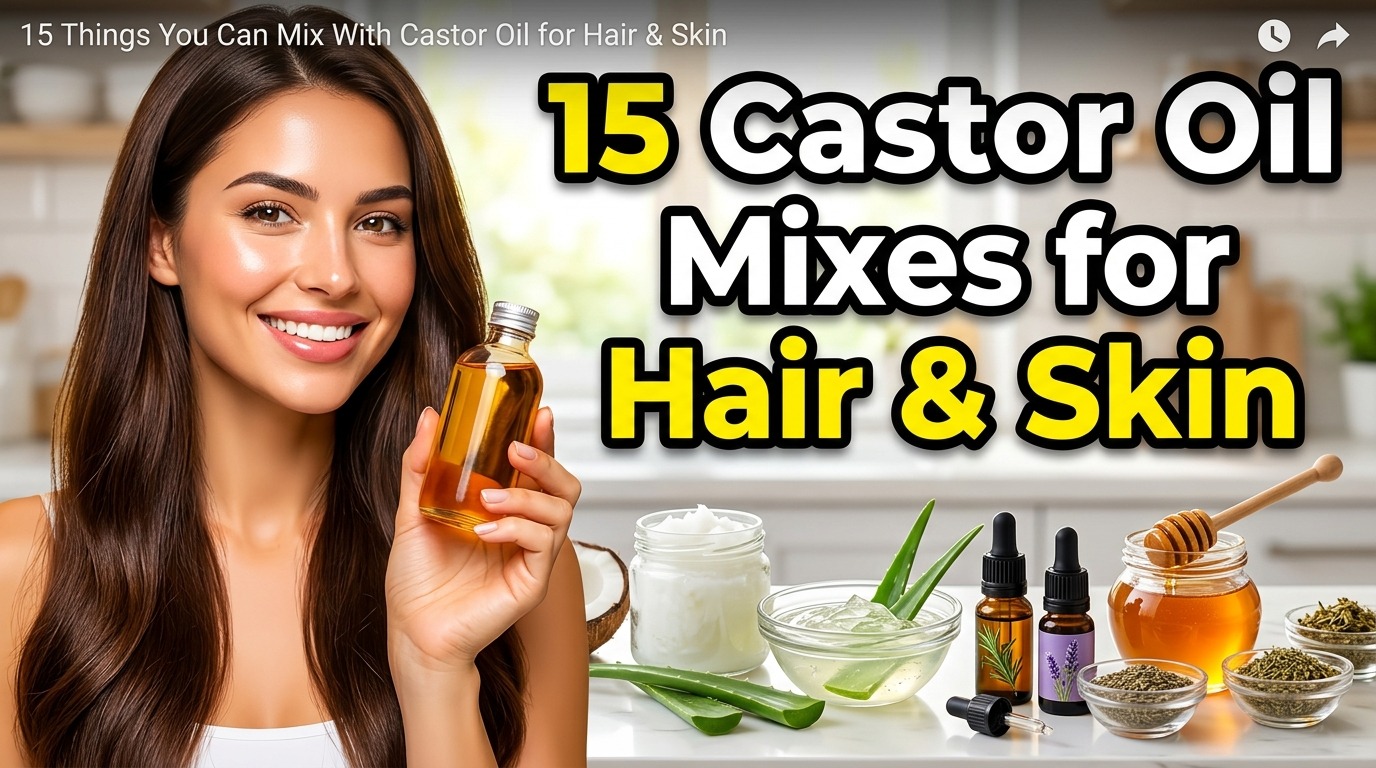
In this guide, we’ll explore 15 things you can mix with castor oil for hair & skin, including ginger, turmeric, tamarind, garlic, onion juice, aloe vera, coconut oil, rosemary, fenugreek, cloves, neem, black seed oil, olive oil, honey, and coffee.
However, there’s an important distinction to make from the beginning.
A traditional remedy can be interesting and may have a long history of use, but that doesn’t automatically mean it has been scientifically proven to treat a medical condition.
Some claims surrounding castor oil combinations have become exaggerated online. Therefore, this article will look at these combinations from a balanced perspective, explaining how they are traditionally used while also highlighting important safety considerations.
Why Do People Mix Castor Oil With Other Ingredients?
Castor oil is derived from the seeds of the castor bean plant, Ricinus communis. One of its most noticeable characteristics is its thick consistency.
This texture makes it useful as a base for various topical preparations.
For example, people may combine castor oil with lighter oils to make it easier to spread through the hair. Others combine it with botanical ingredients because they are interested in the properties of those plants.
Castor oil is particularly popular in natural hair-care routines because it coats the hair shaft and can help reduce the feeling of dryness. It is also used in some skin-care routines as a rich emollient.
However, it is important not to confuse conditioning with treatment.
A product that makes your hair feel softer does not necessarily make it grow faster, and a moisturizer does not necessarily treat an underlying skin disease.
With that in mind, let’s look at some of the most interesting combinations.
Castor Oil and Ginger
One of the more unusual things you can mix with castor oil is ginger.
Ginger has a long history of traditional use and is particularly known for its characteristic warming sensation. When combined with castor oil, ginger may be incorporated into a massage preparation and applied to areas that feel stiff or uncomfortable.
The thick texture of castor oil allows the mixture to remain on the skin during massage, while ginger can provide a warming sensation.
This is one reason castor oil and ginger have become popular in some traditional wellness routines.
However, you should be cautious about dramatic claims you may encounter online. Some sources claim that castor oil and ginger can cure arthritis, nerve pain, or severe inflammation.
There is not enough clinical evidence to support these claims.
Therefore, if you use a castor oil and ginger preparation, think of it as a traditional topical or massage practice rather than a proven medical treatment.
People with sensitive skin should also patch-test the mixture before applying it more extensively.
Castor Oil and Turmeric
Turmeric is another popular ingredient in traditional wellness practices.
Its bright yellow color comes from compounds called curcuminoids, with curcumin being the most extensively studied.
Researchers have investigated curcumin for various biological properties, including its potential anti-inflammatory activity.
Because of this interest, some people combine turmeric with castor oil and apply the mixture to the skin.
The combination may be prepared as a paste or incorporated into a topical treatment.
However, there’s an important scientific distinction.
Research showing biological activity from isolated curcumin does not automatically demonstrate that applying raw turmeric mixed with castor oil to the skin will produce the same effect.
The way an ingredient behaves in a laboratory setting can be very different from how it behaves when applied to human skin.
There’s also a practical issue: turmeric can stain the skin and clothing.
So while castor oil and turmeric may be an interesting traditional combination, it should not be presented as a proven cure for arthritis, inflammation, or other medical conditions.
Castor Oil and Tamarind
Tamarind may be better known as a sour tropical fruit used in cooking, but various parts of the plant have also been used traditionally in wellness practices.
In some traditional preparations, tamarind is combined with oils and used externally.
This makes castor oiland tamarind an especially interesting combination for people exploring traditional beauty and wellness practices.
The mixture may be used as part of a topical preparation or massage routine.
However, scientific evidence specifically examining castor oil and tamarind together for treating medical conditions is extremely limited.
This is particularly important because some online claims suggest that tamarind and castor oil can “draw toxins” from the body.
There is no good scientific basis for treating such claims as established medical facts.
Your body already has highly effective systems for processing and eliminating waste, primarily involving organs such as the liver and kidneys.
So if you encounter this combination online, enjoy the cultural history behind it, but don’t rely on it as a detoxification treatment.
Castor Oil and Garlic
Garlic is another ingredient sometimes added to homemade castor oil preparations.
Garlic contains several sulfur-containing compounds, including allicin, which has been studied for its biological properties.
Some DIY beauty recipes involve crushing fresh garlic and incorporating it into castor oil for use on the scalp or skin.
However, this combination comes with an important warning.
Raw garlic can irritate the skin.
Applying concentrated garlic directly to the skin may cause redness, burning, irritation, and, in some circumstances, chemical burns.
Therefore, garlic should not be treated as a harmless cosmetic ingredient simply because it is commonly eaten as food.
If you see a recipe recommending large amounts of raw garlic on your scalp or skin, approach it cautiously.
A natural ingredient can still be irritating.
Castor Oil and Onion Juice
Onion juice has become particularly popular in natural hair-care circles.
Many DIY hair recipes combine onion juice with castor oil and recommend massaging the mixture into the scalp.
The theory behind these preparations is that onion juice may support the scalp while castor oil helps condition the hair.
There has been limited research investigating onion juice in relation to certain forms of localized hair loss. However, the available evidence is not strong enough to conclude that onion juice is a universal hair-growth treatment.
Adding castor oil doesn’t automatically turn the mixture into a proven treatment for baldness.
If you decide to use this combination, it is more reasonable to think of it as a homemade scalp-care preparation.
And if you’re experiencing sudden, severe, or unexplained hair loss, it’s important to investigate the underlying cause rather than relying exclusively on DIY oils.
Castor Oil and Aloe Vera
Aloe vera is one of the more familiar ingredients on this list.
It is widely used in skin-care products because of its soothing and moisturizing properties.
Castor oil has a rich, oily texture and can help reduce moisture loss from the skin.
Combining aloe vera with castor oil therefore creates an interesting homemade preparation for people interested in skin and scalp care.
This may be particularly appealing for people dealing with dry skin.
However, aloe vera isn’t suitable for everyone.
Some individuals may experience skin irritation or allergic reactions, particularly when using products containing additional ingredients.
Before applying a homemade aloe vera and castor oil mixture to a large area, test it on a small section of skin.
Castor Oil and Coconut Oil
If you’re looking for things you can mix with castor oil for hair, coconut oil is one of the most practical choices.
The reason is simple.
Castor oil is extremely thick and can be difficult to distribute evenly through the hair.
Coconut oil has a lighter texture and can make the overall mixture easier to spread.
The combination is commonly used as a hair-conditioning treatment.
People may apply a small amount to the hair or scalp and leave it on for a period before washing it out.
But there’s an important misconception worth addressing.
Castor oil is frequently advertised as a powerful hair-growth treatment.
There isn’t strong clinical evidence proving that castor oil directly makes hair grow faster.
Instead, its thick, coating texture may help hair feel softer and more conditioned.
When hair is less dry and less prone to breakage, it may appear fuller or healthier.
That is different from actually increasing the biological rate of hair growth.
Castor Oil and Rosemary
Rosemary has become one of the most talked-about botanical ingredients in modern hair care.
Some research has investigated rosemary preparations in relation to hair growth and scalp health, which has contributed to its popularity in natural hair products.
People may combine rosemary with castor oil to create a scalp massage oil.
However, there’s an important distinction between rosemary leaves, rosemary-infused oil, and rosemary essential oil.
Essential oils are highly concentrated.
Applying undiluted essential oils directly to the scalp can cause irritation or other reactions.
Therefore, appropriate dilution is essential.
And while rosemary may be interesting for people looking for natural hair-care options, it should not be treated as a guaranteed cure for hair loss.
If you’re experiencing significant hair thinning, bald patches, or sudden hair loss, consider speaking with a healthcare professional to determine the cause.
Castor Oil and Fenugreek
Fenugreek is another traditional ingredient frequently associated with hair care.
The seeds have been used in food and traditional herbal practices for centuries.
DIY hair recipes sometimes involve soaking or grinding fenugreek seeds and combining them with castor oil to create a scalp or hair treatment.
The resulting mixture may help condition the hair and leave it feeling softer.
However, scientific evidence specifically proving that castor oil and fenugreek can dramatically increase hair growth is limited.
This combination may be interesting as part of a traditional hair-care routine, but it should not be presented as a guaranteed treatment for genetic hair loss.
If your goal is healthier-looking hair, proper cleansing, conditioning, nutrition, and gentle hair-care practices are also important.
Castor Oil and Cloves
Cloves might be one of the most unexpected ingredients you can combine with castor oil.
Cloves contain a naturally occurring compound called eugenol, which contributes to their distinctive smell and has been studied for various biological properties.
Some traditional preparations incorporate cloves or clove oil into carrier oils for topical use.
Castor oil can serve as the carrier oil in such preparations.
However, concentrated clove oil can be irritating.
This is why proper dilution matters.
Never assume that using more essential oil will produce better results.
In fact, excessive concentration can increase the risk of skin irritation.
If you’re experimenting with a cloveand castor oil preparation, use caution and avoid applying concentrated essential oils directly to the skin.
Castor Oil and Neem
Neem has a long history of use in traditional South Asian skin and hair-care practices.
Neem leaves and neem oil contain various plant compounds that have been investigated by researchers.
Some people combine neem oil with castor oil and use the mixture as a topical scalp or skin preparation.
It may be used by people interested in traditional approaches to scalp care or dry skin.
However, neem oil can be quite strong.
Its distinctive smell is another reason many people prefer to dilute it with a carrier oil.
Neem may also cause irritation or allergic reactions in some individuals.
For this reason, a patch test is advisable before applying a neem and castor oil mixture more extensively.
Castor Oil and Black Seed Oil
Black seed oil is derived from Nigella sativa, a plant with a long history of traditional use.
One of its best-known compounds is thymoquinone, which has been studied in laboratory and experimental research.
Because of this scientific interest, black seed oil has become increasingly popular in natural wellness products.
Some people combine black seed oil with castor oil to create a rich botanical mixture for the hair or skin.
The combination may be used as a scalp massage oil or conditioning treatment.
However, laboratory research into thymoquinone does not mean that a homemade castor oil and black seed oil mixture has been proven to cure a disease or reverse hair loss.
This is a common mistake in natural-health discussions.
A promising compound is not automatically a proven treatment.
Castor Oil and Olive Oil
Olive oil is another simple ingredient that pairs naturally with castor oil.
Because olive oil is easier to spread, adding it to castor oil can make the mixture less thick and easier to work through the hair.
Some people also use the combination as a moisturizer for particularly dry areas such as the heels, elbows, cuticles, or hair ends.
The primary benefit here is likely related to conditioning and reducing the feeling of dryness.
You don’t need to make dramatic health claims about the combination for it to have a practical place in a beauty routine.
Sometimes a simple moisturizer is simply a moisturizer.
Castor Oil and Honey
Honey may seem like an unusual partner for castor oil, but the two have complementary properties.
Honey is a humectant, which means it can help attract and retain moisture.
Castor oil, on the other hand, provides a rich oily layer that can help reduce moisture loss.
Because of these properties, DIY beauty enthusiasts sometimes combine honey and castor oil for short-term skin treatments.
However, there’s one obvious problem.
Honey is extremely sticky.
That makes this combination better suited to a controlled, washable skin treatment rather than something you leave on your skin indefinitely.
As with other homemade mixtures, patch-test first if you’re unsure how your skin will react.
Castor Oil and Coffee
And now for perhaps the most surprising combination on the list: coffee.
Ground coffee is sometimes combined with oils to create homemade body scrubs.
When mixed with castor oil, the result is a thick preparation that can be massaged onto the skin for physical exfoliation.
Coffee also contains caffeine, which is why caffeine is included in some cosmetic products designed to improve the temporary appearance of puffiness or cellulite.
But don’t believe exaggerated claims.
A coffee and castor oil scrub will not burn body fat through your skin.
It won’t permanently eliminate cellulite.
And it won’t “detox” your body.
What exfoliation can do is remove some dead skin cells from the surface, leaving the skin temporarily feeling smoother.
That’s a much more realistic expectation.
Which Castor Oil Combinations Are Best for Hair?
After looking at these 15 things you can mix with castor oil for hair & skin, you may be wondering which combinations make the most practical sense.
For basic hair conditioning, castor oil combined with a lighter oil such as coconut oil or olive oil can make the mixture easier to apply.
For scalp-care routines, some people prefer combinations involving rosemary, fenugreek, or black seed oil.
However, if your primary concern is hair loss, it’s important to distinguish between hair conditioning and hair regrowth.
An oil can make hair look healthier without actually stimulating new hair growth.
If you’re experiencing persistent thinning or baldness, consider getting professional advice rather than depending entirely on homemade treatments.
Which Castor Oil Combinations Are Best for Skin?
For skin care, castor oil may be combined with ingredients such as aloe vera, olive oil, honey, or turmeric.
These combinations are generally used as topical preparations rather than medical treatments.
If your primary goal is moisturizing dry skin, a simple combination may be sufficient.
You don’t necessarily need to mix five or six ingredients together.
In fact, the more ingredients you introduce, the more difficult it becomes to determine which one is responsible if your skin reacts badly.
Keeping homemade skin-care routines simple can therefore be a smart approach.
Safety Tips Before Using Castor Oil Mixtures
Before trying any of these 15 things you can mix with castor oil for hair & skin, there are several safety considerations to keep in mind.
First, perform a patch test.
Apply a small amount of the mixture to a limited area of skin and wait to see how your skin responds.
Second, be particularly careful with essential oils.
Rosemary, clove, and other essential oils are highly concentrated. They should not simply be poured directly onto the scalp or skin.
Third, be cautious with raw garlic.
Garlic can cause significant irritation and should not be treated as a harmless topical ingredient.
Fourth, don’t assume that “natural” means “safe.”
Plants contain biologically active chemicals, and some of those chemicals can cause irritation, allergies, or other unwanted effects.
Finally, avoid using homemade mixtures as replacements for medical treatment.
If you have persistent hair loss, severe skin irritation, unexplained pain, or another ongoing health concern, speak with an appropriately qualified healthcare professional.
Can You Drink Castor Oil With These Ingredients?
This is an important question because castor oil is also known as a stimulant laxative.
When taken orally, castor oil can cause bowel contractions and diarrhea.
That does not mean you should start mixing it with ginger, turmeric, coffee, herbs, or other ingredients and drinking the resulting preparation.
A mixture being made from natural ingredients does not automatically make it safe to consume.
In particular, essential oils and concentrated botanical preparations can be dangerous when swallowed.
If you’re considering taking castor oil internally, follow appropriate medical or product guidance rather than experimenting with homemade combinations.
Final Thoughts on Things You Can Mix With Castor Oil
Castor oil has an interesting place in traditional beauty and wellness practices.
Its thick consistency makes it useful in many topical preparations, while its history of use has inspired countless homemade recipes.
From ginger and turmeric to aloe vera, coconut oil, rosemary, fenugreek, neem, black seed oil, and coffee, there are certainly many creative combinations people have experimented with.
But it’s important to maintain realistic expectations.
Some combinations may help condition hair or moisturize the skin.
Others may simply be traditional practices with limited scientific evidence.
And some of the more dramatic claims circulating online are not supported by good evidence.
The best approach is to stay curious without abandoning common sense.
If you’re interested in trying any of these combinations, start with a simple preparation, use a small amount, patch-test your skin, and pay attention to how your body responds.
Most importantly, don’t use homemade remedies to delay appropriate medical care.
At My Emerald Health, our goal is to explore natural wellness while helping you separate useful information from exaggerated health claims.
If you’d like to try some of the products mentioned in this article, you can find recommended castor oil, hair-care, skin-care, and wellness products through the links provided on this page. Always read the product label, ingredients, directions, and safety information before using a new product.
Some links may be affiliate links, which means we may receive a small commission if you make a purchase through them, at no additional cost to you. This helps support My Emerald Health and allows us to continue producing helpful health and wellness content.
Which of these castor oil combinations have you tried before?
Have you ever mixed castor oil with coconut oil, rosemary, ginger, turmeric, aloe vera, or another ingredient?
Share your experience in the comments.
And if you found this article helpful, explore more natural wellness, hair-care, skin-care, nutrition, and healthy-living content from My Emerald Health.
A graduate of Computer Science and Information Management Technology. Diploma – Caregiving, Certificates – Dementia and Diabetes Awareness and Management. A researcher, blogger, songwriter, singer and acoustic guitarist. Born in an environment where natural talents such as healing are imparted at our natural birth. This natural talents of healing is the result of our genetic inheritance and the training from family environment.
Related Posts:
Uses of Castor Beans Healthful Uses of Castor Beans It is quite imperative that…
We use cookies on our website to give you the most relevant experience by remembering your preferences and repeat visits. By clicking “Accept All”, you consent to the use of ALL the cookies. However, you may visit "Cookie Settings" to provide a controlled consent.
This website uses cookies to improve your experience while you navigate through the website. Out of these, the cookies that are categorized as necessary are stored on your browser as they are essential for the working of basic functionalities of the website. We also use third-party cookies that help us analyze and understand how you use this website. These cookies will be stored in your browser only with your consent. You also have the option to opt-out of these cookies. But opting out of some of these cookies may affect your browsing experience.
Necessary cookies are absolutely essential for the website to function properly. These cookies ensure basic functionalities and security features of the website, anonymously.
Cookie
Duration
Description
cookielawinfo-checkbox-analytics
11 months
This cookie is set by GDPR Cookie Consent plugin. The cookie is used to store the user consent for the cookies in the category "Analytics".
cookielawinfo-checkbox-functional
11 months
The cookie is set by GDPR cookie consent to record the user consent for the cookies in the category "Functional".
cookielawinfo-checkbox-necessary
11 months
This cookie is set by GDPR Cookie Consent plugin. The cookies is used to store the user consent for the cookies in the category "Necessary".
cookielawinfo-checkbox-others
11 months
This cookie is set by GDPR Cookie Consent plugin. The cookie is used to store the user consent for the cookies in the category "Other.
cookielawinfo-checkbox-performance
11 months
This cookie is set by GDPR Cookie Consent plugin. The cookie is used to store the user consent for the cookies in the category "Performance".
viewed_cookie_policy
11 months
The cookie is set by the GDPR Cookie Consent plugin and is used to store whether or not user has consented to the use of cookies. It does not store any personal data.
Functional cookies help to perform certain functionalities like sharing the content of the website on social media platforms, collect feedbacks, and other third-party features.
Performance cookies are used to understand and analyze the key performance indexes of the website which helps in delivering a better user experience for the visitors.
Analytical cookies are used to understand how visitors interact with the website. These cookies help provide information on metrics the number of visitors, bounce rate, traffic source, etc.
Advertisement cookies are used to provide visitors with relevant ads and marketing campaigns. These cookies track visitors across websites and collect information to provide customized ads.