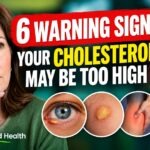
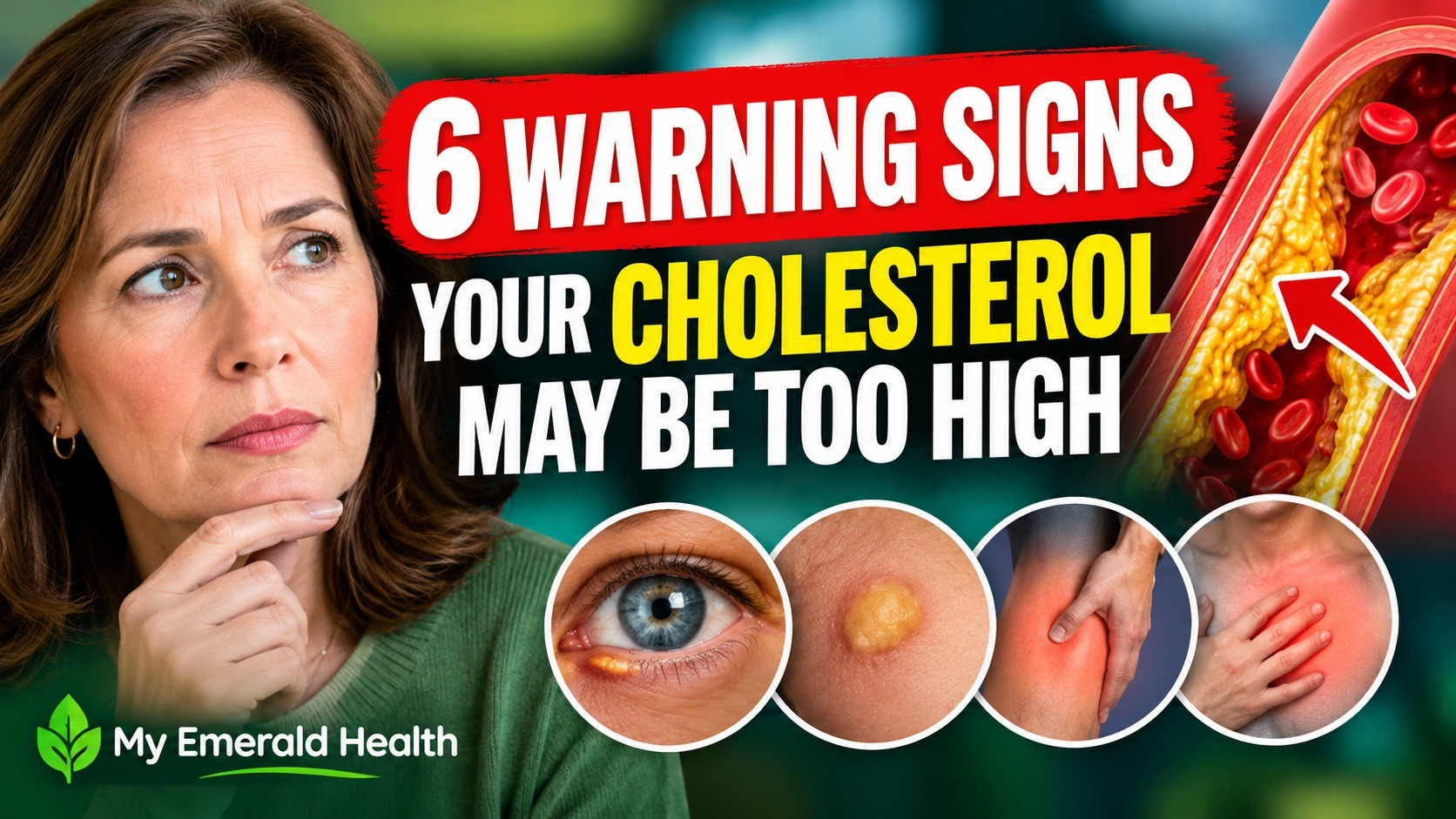
Discover 6 warning signs your cholesterol may be too high, including unusual eye and skin changes, circulation problems, and important risk factors. Learn why high cholesterol can be silent and why checking your cholesterol levels matters for heart health. Watch now on My Emerald Health.
Have you ever wondered if something could be happening inside your body without you feeling sick at all?
You wake up feeling normal.
You go about your day.
You eat, work, exercise, sleep—and everything seems fine.
But there may be one important number inside your body that you simply cannot feel.
Your cholesterol.
And here’s what makes cholesterol so interesting—and potentially dangerous.
High cholesterol usually does not cause obvious symptoms.
In other words, you can feel completely healthy while cholesterol is gradually contributing to plaque buildup inside your arteries.
So how can you know if something might be wrong?
There are certain changes and warning signs that can sometimes be associated with very high cholesterol or cholesterol-related complications.
And in today’s video, we’re looking at six warning signs your cholesterol may be too high—including some that can appear in unexpected places on your body.
Stay with me until number six, because the last one is something you may notice every morning but probably never connected with cholesterol.
And remember, these signs do not prove that you have high cholesterol. The only reliable way to know your cholesterol level is through a blood test.
Welcome back to My Emerald Health, where we make important health information simple and practical.
Let’s get started.
Number one: yellowish deposits around your eyes.
Look closely at the skin around your eyelids.
Have you ever noticed small yellowish patches, especially near the inner corners of your eyes?
One possible explanation is a condition called xanthelasma.
These are yellowish deposits that can contain cholesterol and other substances.
They are often found around the eyelids and may appear as soft, yellow or slightly raised patches.
Some people with these deposits have normal cholesterol levels.
But because they can be associated with abnormal blood lipid levels, especially in some people with very high cholesterol, they are worth discussing with a healthcare professional.
So if you notice a new yellowish patch around your eyelids, don’t panic.
Instead, consider getting your cholesterol checked.
Sometimes your skin can give you a reason to investigate what’s happening beneath it.
Number two: unusual yellowish bumps or nodules on the skin.
These are sometimes called xanthomas.
Xanthomas occur when certain fats, including cholesterol, accumulate in tissues.
They can appear in different areas of the body.
You might notice them around the elbows, knees, hands, feet, tendons, or other areas.
One particularly important type is called a tendon xanthoma.
These deposits can sometimes be associated with extremely high cholesterol levels and certain inherited cholesterol disorders.
And that is why this sign deserves attention.
If someone develops unusual yellowish or firm deposits under the skin—especially if they appear on multiple areas of the body—it shouldn’t simply be dismissed as an ordinary skin problem.
A doctor can examine the area and, if appropriate, order a lipid panel to check cholesterol and triglyceride levels.
The key message here is simple:
Don’t diagnose yourself from the appearance of a bump—but don’t automatically ignore unusual changes either.
WARNING SIGN #3 — A GRAY OR WHITE RING AROUND THE CORNEA
Number three is one many people notice without realizing what it could mean.
It’s called corneal arcus.
Imagine looking into someone’s eyes and noticing a grayish, white, or slightly bluish ring around the outer edge of the colored part of the eye.
That ring can be caused by deposits of lipids in the cornea.
In older adults, corneal arcus can occur naturally with aging and does not necessarily mean that a person has high cholesterol.
But when a similar finding appears in a younger person, particularly before around age 40, it can be a reason to investigate cholesterol levels and possible inherited lipid disorders.
Again, this isn’t a diagnosis.
It’s a clue.
And that’s an important distinction throughout this video.
Your eyes cannot tell you your exact cholesterol number.
But certain eye findings can sometimes give doctors another reason to look deeper.
So if you’ve noticed a pronounced gray or white ring around your cornea, especially at a younger age, mention it during your next medical evaluation.
Now we’re moving from visible signs to something much more serious.
Number four: chest pain, pressure, or discomfort during physical activity.
High cholesterol itself usually doesn’t cause chest pain.
But over time, excess LDL cholesterol can contribute to the development of atherosclerosis—the buildup of plaque inside arteries.
As plaque accumulates, arteries can become narrower and less able to deliver blood efficiently.
If the arteries supplying the heart become significantly narrowed, a person may experience symptoms such as pressure, squeezing, heaviness, or discomfort in the chest, particularly during exertion.
Some people may also experience shortness of breath, unusual fatigue, or discomfort spreading to the arm, shoulder, neck, jaw, or back.
This is not something to watch casually.
If you experience new, severe, or persistent chest pressure or pain—especially with shortness of breath, sweating, nausea, fainting, or pain spreading to the arm or jaw—seek emergency medical care immediately.
Don’t wait for a cholesterol test.
Don’t wait for tomorrow.
Heart-related symptoms require prompt attention.
WARNING SIGN #5 — PAIN OR CRAMPING IN YOUR LEGS WHEN WALKING
Leg pain or cramping that repeatedly appears when you walk and improves when you rest.
This may sound like a simple muscle problem.
But in some people, this pattern can be associated with peripheral artery disease, or PAD.
PAD occurs when arteries supplying the limbs become narrowed, often because of atherosclerosis.
One classic symptom is called intermittent claudication.
A person may develop aching, cramping, heaviness, or fatigue in the calf, thigh, or buttock after walking a certain distance.
Then, after stopping and resting for a few minutes, the discomfort improves.
They start walking again—and it comes back.
That repeated pattern is important.
High cholesterol is one of several risk factors for atherosclerosis and peripheral artery disease.
So if your legs repeatedly hurt when walking but improve when you stop, don’t automatically assume it’s simply because you’re getting older or out of shape.
Talk to a healthcare professional.
Your legs may be telling you something about your circulation.
WARNING SIGN #6 — A FAMILY HISTORY OF VERY HIGH CHOLESTEROL OR EARLY HEART DISEASE
It isn’t something you see in the mirror.
It’s something you may discover by looking at your family history.
If close family members have had extremely high cholesterol, heart attacks, or cardiovascular disease at unusually young ages, your own cholesterol deserves attention.
Why?
Because some people inherit genetic conditions that cause very high LDL cholesterol.
One example is familial hypercholesterolemia, often shortened to FH.
People with FH can have very high LDL cholesterol from a young age.
And because cholesterol exposure can accumulate over many years, untreated FH can substantially increase the risk of cardiovascular disease at a younger age.
Here’s the important part.
You may feel perfectly healthy.
You may exercise.
You may have a healthy weight.
You may not smoke.
And you can still have genetically elevated cholesterol.
That’s why family history can be such a valuable clue.
If a parent, sibling, or child has been diagnosed with very high cholesterol—or if close relatives have experienced heart attacks or other cardiovascular disease unusually early—tell your healthcare professional.
It may be appropriate to have your cholesterol checked and, depending on your situation, discuss whether additional evaluation is needed.
Now let’s step back for a moment.
We’ve talked about six warning signs and clues:
Yellowish deposits around the eyes.
Unusual cholesterol-related bumps on the skin.
A gray or white ring around the cornea, particularly at a younger age.
Chest discomfort that could indicate an underlying cardiovascular problem.
Leg pain with walking that may indicate poor circulation.
And a strong family history of very high cholesterol or early cardiovascular disease.
But there’s something even more important.
You can have high cholesterol without any of these signs.
That’s why cholesterol is often called a silent risk factor.
You cannot look in the mirror and accurately determine your cholesterol level.
You cannot rely on how energetic you feel.
And you cannot assume that being thin automatically means your cholesterol is healthy.
The real answer comes from a lipid blood test.
Depending on the test, your results may include LDL cholesterol, HDL cholesterol, triglycerides, and total cholesterol.
Your healthcare professional can interpret those numbers in the context of your age, medical history, blood pressure, smoking status, diabetes risk, family history, and overall cardiovascular risk.
So what can you do if you’re concerned?
Start with information—not fear.
If you haven’t had your cholesterol checked recently, ask a healthcare professional whether a lipid panel is appropriate for you.
Then look at your lifestyle.
A heart-healthy eating pattern can make a meaningful difference.
Focus more on vegetables, fruits, whole grains, beans, nuts, seeds, and other minimally processed foods.
Choose healthier sources of fat more often and limit foods high in saturated and trans fats.
Regular physical activity can also support cardiovascular health.
And if you smoke,quitting is one of the most important things you can do for your heart and blood vessels.
If your cholesterol is significantly elevated, lifestyle changes may not be enough by themselves.
Some people need medication, particularly when LDL cholesterol is very high or when their overall cardiovascular risk is elevated.
That’s a conversation to have with your healthcare professional.
And don’t stop or start cholesterol medication based on something you hear in a YouTube video.
And if you’re looking for some of the health and wellness products we recommend for supporting a healthier lifestyle, you’ll find links to our recommended products in the description below.
Take a look at those links if you’d like to see the products we’ve selected.
Just remember: supplements and wellness products should complement—not replace—a healthy diet, appropriate medical care, and prescribed treatment.
So, here’s the biggest takeaway from today’s video.
High cholesterol can be surprisingly quiet.
You may not feel it.
You may not see it.
And you may have no obvious warning signs at all.
That’s why knowing your numbers matters.
If you’ve noticed any of the unusual signs we’ve discussed—or if high cholesterol or early heart disease runs in your family—consider talking with a healthcare professional about getting your cholesterol checked.
And here’s a question for you:
When was the last time you had your cholesterol tested?
Was it within the last year, several years ago, or honestly—you can’t remember?
Let us know in the comments.
And if this video helped you understand your cholesterol a little better, don’t forget to like this video, subscribe to My Emerald Health, and turn on notifications so you don’t miss our next health video.
Take care of your body, pay attention to the signals it gives you, and remember:
Your health is one investment you cannot afford to ignore.
A graduate of Computer Science and Information Management Technology. Diploma – Caregiving, Certificates – Dementia and Diabetes Awareness and Management. A researcher, blogger, songwriter, singer and acoustic guitarist. Born in an environment where natural talents such as healing are imparted at our natural birth. This natural talents of healing is the result of our genetic inheritance and the training from family environment.
We use cookies on our website to give you the most relevant experience by remembering your preferences and repeat visits. By clicking “Accept All”, you consent to the use of ALL the cookies. However, you may visit "Cookie Settings" to provide a controlled consent.
This website uses cookies to improve your experience while you navigate through the website. Out of these, the cookies that are categorized as necessary are stored on your browser as they are essential for the working of basic functionalities of the website. We also use third-party cookies that help us analyze and understand how you use this website. These cookies will be stored in your browser only with your consent. You also have the option to opt-out of these cookies. But opting out of some of these cookies may affect your browsing experience.
Necessary cookies are absolutely essential for the website to function properly. These cookies ensure basic functionalities and security features of the website, anonymously.
Cookie
Duration
Description
cookielawinfo-checkbox-analytics
11 months
This cookie is set by GDPR Cookie Consent plugin. The cookie is used to store the user consent for the cookies in the category "Analytics".
cookielawinfo-checkbox-functional
11 months
The cookie is set by GDPR cookie consent to record the user consent for the cookies in the category "Functional".
cookielawinfo-checkbox-necessary
11 months
This cookie is set by GDPR Cookie Consent plugin. The cookies is used to store the user consent for the cookies in the category "Necessary".
cookielawinfo-checkbox-others
11 months
This cookie is set by GDPR Cookie Consent plugin. The cookie is used to store the user consent for the cookies in the category "Other.
cookielawinfo-checkbox-performance
11 months
This cookie is set by GDPR Cookie Consent plugin. The cookie is used to store the user consent for the cookies in the category "Performance".
viewed_cookie_policy
11 months
The cookie is set by the GDPR Cookie Consent plugin and is used to store whether or not user has consented to the use of cookies. It does not store any personal data.
Functional cookies help to perform certain functionalities like sharing the content of the website on social media platforms, collect feedbacks, and other third-party features.
Performance cookies are used to understand and analyze the key performance indexes of the website which helps in delivering a better user experience for the visitors.
Analytical cookies are used to understand how visitors interact with the website. These cookies help provide information on metrics the number of visitors, bounce rate, traffic source, etc.
Advertisement cookies are used to provide visitors with relevant ads and marketing campaigns. These cookies track visitors across websites and collect information to provide customized ads.